
Daily Sounds Destroying Your Ears: Noise-Induced Hearing Loss
This article explains the biology of noise-induced hearing loss (NIHL) - what's happening inside your cochlea when everyday sounds damage it, why that damage doesn't reverse, and what you can actually do to protect the hearing you still have. If you've ever wondered why your ears ring after a commute or a gym session, this is the explanation you've been missing.
Nate Always
16 min
About three years ago, I started noticing a high-pitched whine in my ears after a concert. I'd had ringing before - everyone has - but this one didn't leave by morning. It was still there a week later. Then a month later. Now it's just there, all the time, like a background frequency I've learned to live with but can never fully escape.
What bothered me most wasn't the concert. It was realising, after the fact, that the concert was probably just the tipping point. The real damage had been building for years before that night - from morning commutes with the windows down, from mowing the lawn without ear protection, from gym earbuds cranked up high enough to drown out the weights clanging around me.
I'd been treating my ears like they were indestructible. They're not. And here's what I wish someone had explained to me before the ringing started.
Key Takeaways
- Noise-induced hearing loss (NIHL) is completely preventable, but permanently irreversible once it occurs - the hair cells inside your cochlea don't grow back.
- 85 decibels is where cumulative damage begins, and sounds that feel comfortable can sit right at or above that threshold.
- Urban traffic, household appliances, and personal audio devices are the three main sources of unrecognised hearing damage in daily life.
- Tinnitus (the ringing or buzzing sound) is typically your damaged hair cells misfiring electrical signals to your brain - it's a symptom, not the underlying problem.
- Consistent, simple protection - earplugs, volume limits, windows up - reduces your weekly noise dose more than most people realise.
Who This Article Is For
This article is for you if you commute through heavy traffic, use earbuds daily, do your own yard work, or have noticed ringing in your ears that wasn't there a few years ago. It's for people between 25 and 50 who haven't thought much about hearing health because nothing has obviously gone wrong yet. If you've been assuming that hearing loss is something that happens to older people or industrial workers, this article is specifically for you. It is not for people experiencing sudden hearing loss, vertigo, or pulsatile tinnitus - those symptoms need immediate medical evaluation, not a health article.
Table of Contents
- What Noise-Induced Hearing Loss Actually Is
- How Your Ears Work and Why the Damage is Permanent
- What Tinnitus Is Telling You About Your Hair Cells
- The 85 Decibel Threshold You've Probably Never Heard Of
- The Three Sources Most People Never Think to Protect Against
- What Actually Works for Protecting Your Remaining Hearing
What Noise-Induced Hearing Loss Actually Is
Most people think hearing loss comes from obvious, dramatic noise. Explosions. Construction sites. Rock concerts. The reality is more ordinary, and more unsettling.
Noise-induced hearing loss (NIHL) is hearing damage caused by sound exposure - either from a single extremely loud event (acoustic trauma), or more commonly, from repeated exposure to moderately loud sound over months and years. The moderately loud version is what most of us are accumulating without realising it.
According to the National Institute on Deafness and Other Communication Disorders, approximately 15% of Americans aged 20 to 69 have hearing loss that may be attributable to noise exposure in work or leisure contexts. That's around 26 million people with preventable hearing damage. A 2017 study published in JAMA Otolaryngology found that among young adults aged 20 to 29 with clinically normal hearing, 25% already showed early signs of noise-induced damage at specific frequencies when more sensitive testing was applied.
The damage starts long before you notice it. That's the problem.
How Your Ears Work and Why the Damage is Permanent
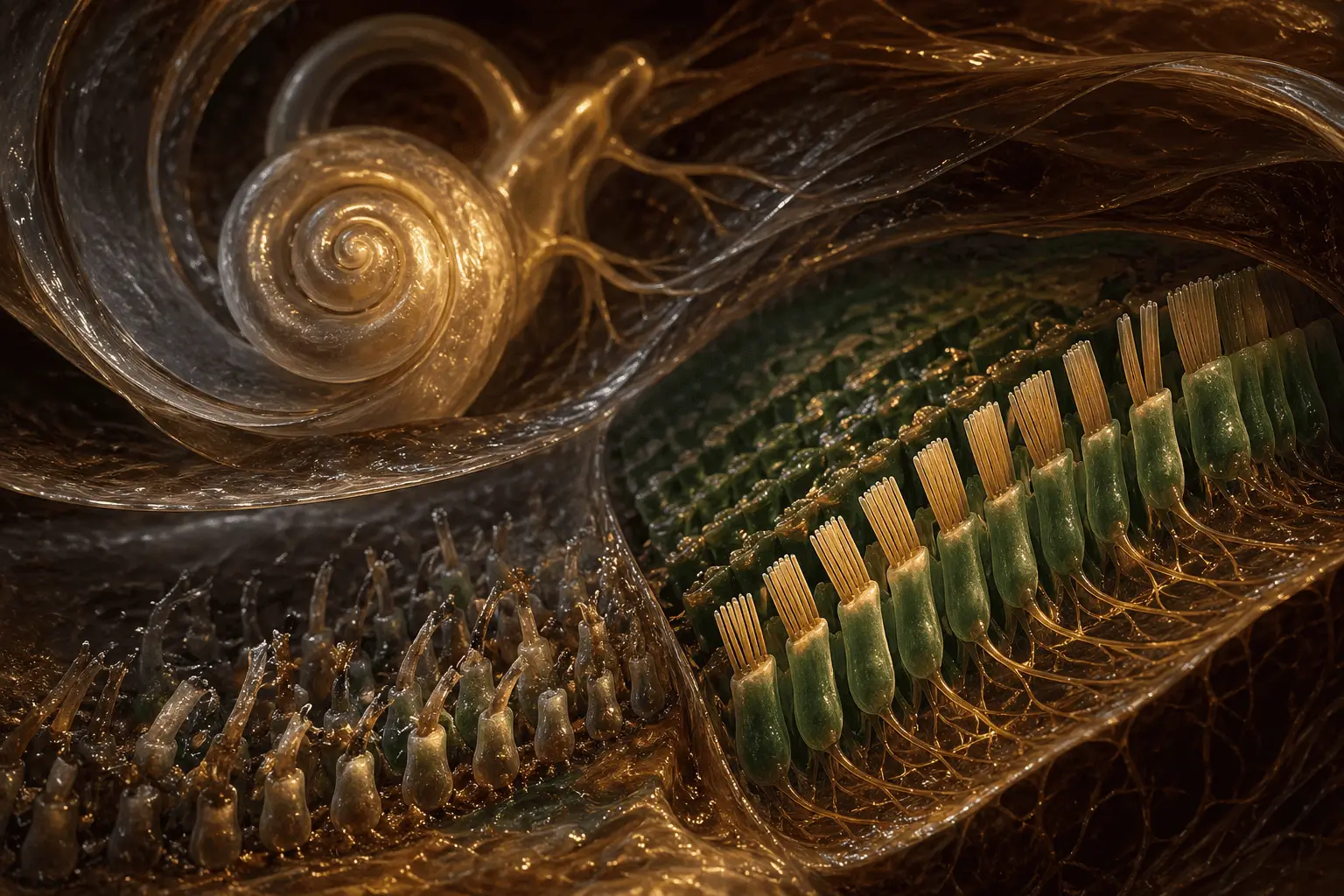
Inside your inner ear, coiled inside the cochlea, you have approximately 15,000 microscopic sensory cells called cochlear hair cells. They're not actually hair - they're specialised cells with tiny hair-like projections called stereocilia on top. Each one is tuned to detect a specific sound frequency.
Here is the chain: sound waves enter your ear, cause fluid inside the cochlea to vibrate, that vibration bends the stereocilia on the relevant hair cells, and those cells generate electrical signals that travel along the auditory nerve to your brain. Your brain reads those signals as sound. The whole process happens in milliseconds, continuously, every waking moment of your life.
Loud noise damages those hair cells through two distinct mechanisms.
The first is mechanical. Intense sound waves bend the stereocilia too far - past the point they can spring back. Think of bending a paperclip repeatedly until it snaps. A single extremely loud sound can do this instantly. Repeated moderately loud exposure does it slowly, cell by cell.
The second is metabolic. A 2016 study in Hearing Research found that sustained noise creates an overload of reactive oxygen species (free radicals) inside the cochlea. That oxidative damage continues even after the noise stops. Your ears are still being damaged after you've left the loud environment.
Here's the part that matters most: mammals cannot regenerate cochlear hair cells. Birds can. Fish can. We can't. A 2009 landmark study in The Journal of Neuroscience found that even "temporary" hearing loss from noise exposure - the kind that seems to recover by the next morning - causes permanent damage to the synaptic connections between hair cells and nerve fibers. You may feel like your hearing came back. The degradation has still begun.
When those cells are gone, that frequency is gone. No supplement, no therapy, and no device currently available to humans reverses that.
What Tinnitus Is Telling You About Your Hair Cells
Tinnitus is the perception of sound with no external source. Ringing is the most common description, but people also report buzzing, hissing, whistling, or a low roar. According to the American Tinnitus Association, around 50 million Americans experience some degree of tinnitus.
Here's what's producing the sound. When cochlear hair cells are damaged or dying, they can send erratic electrical signals to the auditory nerve even when no sound is entering the ear. Your brain interprets those signals as real sound. Additionally, when hair cells for certain frequencies are lost, the brain sometimes increases its sensitivity to nearby frequencies to compensate - and that compensatory adjustment creates phantom sounds you can't turn off.
A 2015 study in Trends in Cognitive Sciences showed that tinnitus isn't just a problem in the ear. The damaged peripheral system (your cochlea) triggers neuroplastic changes in the central auditory system (your brain). The brain reorganises around the loss. That's why tinnitus persists even when the original noise exposure has long stopped, and why it typically doesn't go away once it becomes chronic.
A 2019 study in Progress in Brain Research found that stress amplifies tinnitus through cortisol-mediated increases in auditory cortex excitability. Stress makes your brain more reactive to the misfiring signals. The ringing gets louder. The louder it gets, the more stressful it becomes. That cycle is real, and it's why tinnitus often feels worst at the end of hard days and better on rested, quieter ones.
If you have ringing that only appears after noise exposure and goes within 24 hours, that's a warning. If it's becoming chronic - present most of the time, audible in quiet rooms, still there weeks later - the underlying damage is likely permanent.
The 85 Decibel Threshold You've Probably Never Heard Of
Sound intensity is measured in decibels (dB). The scale is logarithmic, which means every 10 dB increase represents a tenfold increase in intensity. An 80 dB sound isn't slightly louder than 70 dB. It's ten times more intense.
Here's the exposure framework you need to understand:
| Decibel Level | Equivalent Sound | Safe Exposure Duration |
|---|---|---|
| 70 dB and below | Normal conversation | Unlimited |
| 85 dB | Heavy city traffic, vacuum cleaner | 8 hours maximum |
| 88 dB | Lawnmower | 4 hours |
| 91 dB | Motorcycle | 2 hours |
| 94 dB | Leaf blower | 1 hour |
| 100 dB | Earbuds at high volume | 15 minutes |
| 120 dB+ | Gunshot, jet engine at close range | Immediate damage |
The National Institute for Occupational Safety and Health (NIOSH) identifies 85 dB as the maximum safe exposure level for an 8-hour period. For every 3 dB above that, safe exposure time is cut in half.
A free decibel meter app on your phone is enough to start measuring your actual exposure. I did this about two years ago and found my gym averaged 85 to 88 dB during peak hours. My commute with windows down: 82 to 88 dB. My vacuum cleaner: 87 dB. I was spending more than 15 hours each week in the damage zone without knowing it.
The Three Sources Most People Never Think to Protect Against
Urban Traffic
Heavy urban traffic consistently produces 80 to 90 dB. If you commute by car with the windows down, or walk alongside busy roads, you're in the damage zone for the duration of that commute. A 2017 study in International Journal of Environmental Research and Public Health measured daily noise exposure in urban commuters and found that people with 60-plus minute daily commutes accumulated noise doses equivalent to 40% of occupational noise limits - just from getting to work.
Over a working year, that's significant cumulative exposure on top of everything else your ears are dealing with.
Keeping your car windows up in heavy traffic reduces your exposure by approximately 10 to 15 dB - enough to move you out of the damage range. If you walk or cycle commute, musician's earplugs (which reduce volume while preserving sound quality and situational awareness) are worth the small investment.
Common Household Appliances
Your home contains multiple noise sources that regularly hit or exceed 85 dB. Blenders and food processors sit at 85 to 90 dB. Vacuum cleaners reach 70 to 85 dB (commercial-grade models can hit 90 dB). Hair dryers produce 80 to 90 dB held directly next to your ear canal. Power tools typically run 90 to 100 dB. Lawn mowers sit at 85 to 90 dB; leaf blowers reach 90 to 100 dB.
A 2014 study in Journal of Occupational and Environmental Hygiene found that cumulative noise exposure from routine household tasks - daily cooking and cleaning combined with weekly yard maintenance - could exceed occupational noise limits for people who performed these without hearing protection.
These aren't dramatic exposures. They're ten minutes here, twenty minutes there. But they add up across a week, a year, a decade.
Foam earplugs cost about $10 for 50 pairs and reduce noise by 20 to 30 dB. That's enough to bring your vacuum cleaner from the damage zone to well below it. Five seconds to insert. The return is significant.
Personal Audio Devices
This is where the most overlooked damage is happening for people under 45. Smartphones and music players can output 100 to 110 dB through earbuds. Many people listen at 70 to 80% volume, which typically produces 85 to 95 dB - right at or above the damage threshold - for hours at a time.
Why personal audio is uniquely risky: earbuds deliver sound directly into the ear canal with no distance-based reduction in intensity. The hair cells receive the full volume with zero natural attenuation. And because people often listen in noisy environments (subways, gyms, busy offices), they unconsciously turn the volume up to overcome ambient noise, often reaching 90 to 100 dB without realising it.
A 2010 study in JAMA tested young adults aged 20 to 29 with clinically normal hearing. Despite passing standard hearing exams, 25% showed early signs of noise-induced damage at extended frequencies. Personal audio device use was the primary suspected cause. A 2009 study in Noise and Health found that 49.8% of regular personal audio device users listened at potentially dangerous volumes.
The 60/60 rule exists for good reason: no more than 60% of maximum volume for no more than 60 continuous minutes. Most smartphones now also allow you to set a maximum volume cap in the settings. That cap is worth enabling.
What Actually Works for Protecting Your Remaining Hearing
I want to be honest about something before this section: the strategies below won't reverse existing damage. They won't stop tinnitus that's already established. What they do is slow or stop the accumulation of further damage. That matters. Hearing loss is progressive, and protecting what you have now determines what you'll have in ten years.
Reduce noise at the source where you can:
- Keep car windows up in traffic (10 to 15 dB reduction)
- Check dB ratings when buying appliances - quieter models exist
- Keep lawn equipment maintained properly (dull blades increase noise output)
Use physical protection consistently:
- Foam earplugs (NRR 29 to 33) for high-noise household tasks and yard work
- Musician's earplugs for situations where you need situational awareness but volume reduction (commuting, restaurants, live events)
- Over-ear noise-canceling headphones for personal audio use - they require significantly less volume to achieve the same perceived loudness as earbuds
Follow safe listening guidelines:
- The 60/60 rule for all personal audio
- Take listening breaks - give your ears 10 to 15 minutes in quiet for every hour of sustained listening
- If you need to raise your voice to be heard by someone three feet away, you're in a damaging noise environment
Track your actual exposure:
- A free decibel meter app gives you real measurements instead of guesses
- Track your weekly total hours above 85 dB across all sources combined
- A 2010 study in International Journal of Audiology found that consistent hearing protection use in high-noise environments reduced the incidence of noise-induced hearing loss by approximately 75%
Hearing protection doesn't make your ears more sensitive to normal sounds. That's a common misconception worth correcting. Using earplugs in loud environments doesn't cause anything to go wrong in quiet ones. What it does is prevent the damage that would reduce your sensitivity overall.
Frequently Asked Questions
Can noise-induced hearing loss be reversed? No. Once cochlear hair cells are destroyed, they don't regenerate in humans. The hearing loss is permanent. Researchers are working on regenerative therapies, but nothing is currently available or clinically proven for human use. The appropriate response to existing NIHL is protecting your remaining hearing function, not searching for a reversal that doesn't yet exist.
How do I know if I already have NIHL? Early signs include tinnitus that appears after noise exposure, difficulty following conversations in noisy environments, muffled hearing that takes hours to clear after loud events, and needing higher volume on devices over time. An audiologist can confirm it with a comprehensive hearing assessment - and requesting extended high-frequency testing above 8 kHz can detect damage before standard tests flag anything.
Is tinnitus always permanent once it starts? Not always. Tinnitus that follows noise exposure and resolves within 24 to 48 hours may not indicate permanent damage. When it becomes chronic - present most of the time, still there weeks later, audible in quiet rooms - the underlying damage is likely permanent. Severity can fluctuate, but chronic tinnitus typically doesn't disappear completely.
At what volume should I listen to music through headphones? 60% of your device's maximum volume is the evidence-based guideline. Enable your phone's hearing health features and volume limit settings - they exist for exactly this reason and reflect current audio exposure research. If you're in a noisy environment and feel the urge to go above 60%, use noise-canceling headphones instead so you don't need to compete with the ambient noise.
Do noise-canceling headphones actually help? Yes, indirectly. By reducing ambient noise around you, they reduce the volume you need to achieve a comfortable listening level. Switching from earbuds to over-ear noise-canceling headphones typically means needing 20 to 30% less volume to hear the same detail. You can still damage your hearing with noise-canceling headphones if you listen at high volumes - but they make it easier to listen safely.
Can children develop NIHL? Yes, and their ear canals being smaller creates higher sound pressure levels from the same noise source. Rates of hearing loss in adolescents have been increasing, with personal audio device use identified as a primary factor in multiple studies. Children need more conservative listening guidelines than adults, not less. If your kids use headphones regularly, the 60/60 rule applies to them too.
Why does tinnitus get louder at night? Two reasons. First, there's no ambient sound to mask it, so the phantom signal from damaged hair cells is no longer competing with real sound. Second, stress and fatigue affect cortisol levels, which influence auditory cortex excitability. Higher cortisol equals a more reactive auditory system, which amplifies the perceived intensity of the misfiring signals. Tinnitus tracking often reveals a clear pattern: harder days produce louder nights.
What's the difference between tinnitus and pulsatile tinnitus? Standard NIHL tinnitus is a constant tone - ringing, buzzing, hissing - that doesn't change rhythm. Pulsatile tinnitus is rhythmic and matches your heartbeat. It's caused by changes in blood flow near the ear, not damaged hair cells, and it requires medical evaluation to rule out vascular causes. If you hear whooshing or thumping that pulses with your heartbeat, see an ENT rather than treating it as standard tinnitus.
Is one ear being worse than the other a sign of something serious? Asymmetric hearing loss is common with NIHL when noise exposure is asymmetric (phone held to one ear, car window down on one side). But significantly asymmetric hearing loss should always be evaluated by an audiologist or ENT to rule out other causes, including acoustic neuroma or Meniere's disease. Don't assume asymmetry is just pattern variation without getting it checked.
What to Do Next
Download a decibel meter app this week. Free options are available on both iOS and Android. Spend one week measuring the noise levels in your car, gym, kitchen, and wherever you use earbuds. You need real numbers, not guesses.
Set a volume cap on your phone today. Go into your sound or hearing settings and cap the maximum output at 60 to 65% of maximum volume. This takes about two minutes and removes the risk of unconsciously turning it up in noisy environments.
Buy foam earplugs and put them somewhere obvious. A jar in your kitchen, one in your garage, a few in your bag. They need to be within arm's reach to actually get used. Start using them for vacuuming, yard work, and any power tool use.
Track your weekly noise dose for one month. Log every source above 85 dB and its duration. Total those hours weekly. If you're consistently above 8 cumulative hours at 85 dB equivalent, you have a specific problem to address.
Book a baseline hearing assessment with a licensed audiologist. Not a hearing aid dispenser - an audiologist. Ask specifically for extended high-frequency testing above 8 kHz. This gives you a baseline to compare against in future years and may reveal early damage that a standard test misses.
Make one environmental change this week. Pick your single highest-exposure source and address it now. For most people reading this, that's either the commute or the earbuds. One change, implemented consistently, makes a real difference over time.
This article is for informational purposes only and does not constitute medical advice. Always consult a qualified healthcare professional before making changes to your health routine. If you are experiencing sudden hearing loss, vertigo, or pulsatile tinnitus, seek medical attention promptly.
Tags:
tinnitus
hearing loss
inflammation
everyday noises
tinnitus prevention
noise-induced hearing loss
NIHL
personal audio devices
hearing protection
decibel exposure
irreversible hearing loss
ear health
safe listening levels