
Can 5 Minutes of Workout Actually Build Your Ideal Body? Here Is What I Discovered.
If you have tried to build a home workout habit and given up because it felt like you were not doing enough, this article is for you. We are going to break down what 5 focused minutes of movement can actually do for a beginner, the biology behind it, a real routine to start with, and the principle that turns a 5-minute habit into a genuinely transforming one over time.

Nate Always
14 min
Let me be honest with you upfront. If your ideal body is the kind Ronnie Coleman or Arnold Schwarzenegger built, 5 minutes might get you to where Arnold was before he ever stepped into a gym. Just joking, but you get it.
If you are a beginner who wants to build real discipline and consistency at home without overthinking the whole thing, keep reading, because I want to show you something I stumbled across during my own training that genuinely changed how I thought about this.
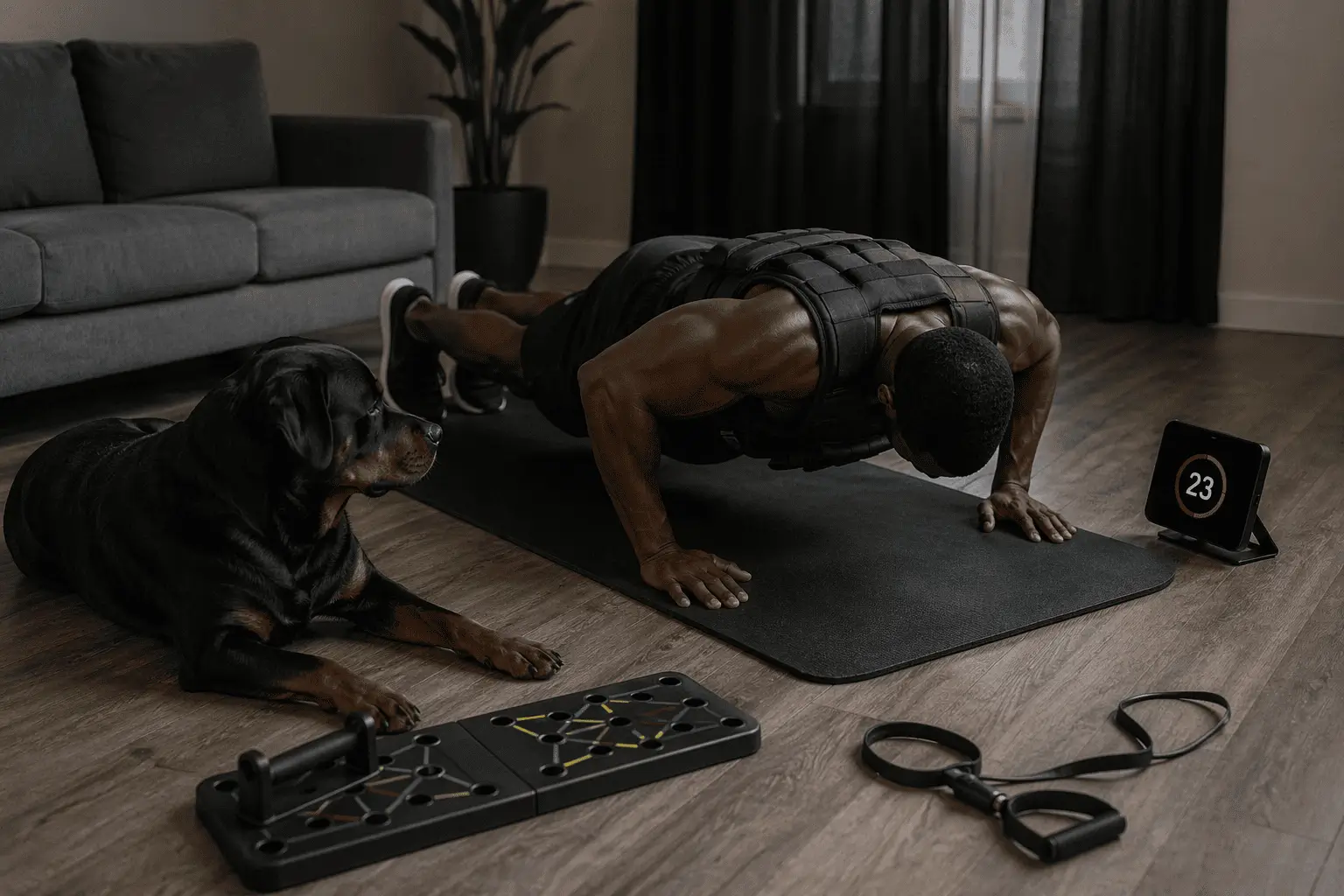
I used to track my rest periods with a stopwatch but never tracked the full session. One day, mid-workout, I forgot to reset the stopwatch. I did 40 push-ups (not the fast, sloppy kind you see all over social media, but the controlled, rhythmic kind where you hold the right angle, tighten the right muscles, and let your chest actually touch the floor), and when I looked at the stopwatch, the whole set had taken just over a minute. The full session, minus rest, was under 5 minutes.
I had been completely overthinking it.
Here is the thing about time and effort: the minutes feel like hours when you are watching them. Think about being stuck in traffic after a long day, energy depleted, just wanting to get home. Five minutes at a standstill feels endless. Home workouts work the same way. When you are focused on form and output rather than the clock, 5 minutes of quality movement is genuinely more than enough to challenge a beginner's body. Done consistently, it is the foundation everything else builds on.
Key Takeaways
- Five minutes of controlled, focused movement is enough to challenge a beginner's body and build the consistency that makes progress possible.
- Most beginners fail not because they do too little, but because they try to do too much too soon. Quality of movement beats quantity of time every time.
- The 5-minute routine in this article covers pushing, lower body, and cardio in a single short session with no equipment required.
- Progressive overload, the principle of gradually increasing the challenge on your body, is what turns a beginner habit into real, sustained physical development.
- Rest, sleep, and nutrient-dense food are not optional extras. They are where your body actually builds the muscle your workouts signal it to grow.
Who This Article Is For
This article is for you if you are not a gym person and have no plans to become one, at least not yet. You want to build some physical discipline, feel better in your body, and stop the cycle of starting a routine and abandoning it two weeks later. You are not training for a competition. You are training to become someone who trains consistently. That distinction matters, and it shapes everything about the approach below.
Table of Contents
- Why Most Beginners Fail, and Why It Is Not Their Fault
- What 5 Minutes of Real Work Actually Looks Like
- The 5-Minute Beginner Routine (No Equipment Needed)
- Progressive Overload: The Principle That Makes This Grow With You
- The Story of Milo, Why Gradual Challenge Is the Only Method That Works
- What Workout Alone Cannot Do
1. Why Most Beginners Fail, and Why It Is Not Their Fault
If you have tried working out at home and given up, there is a good chance you were operating on a wrong assumption. The assumption is this: more is better. More reps, more time, more intensity. You saw the workout clips, the high-octane sets, the people who look like they have been training for years, and you measured your beginner sessions against that standard.
That's not a motivation problem. It's a framing problem.
The truth is that your body, specifically a body that is new to structured movement, does not need 45-minute sessions to be genuinely challenged. It needs the right stimulus, applied consistently, with enough recovery built in. A 5-minute session that actually taxes your muscles is more effective than a 30-minute session done sloppily because you ran out of energy after the first 10 minutes.
The goal at this stage is not maximum output. It's to build a movement signal your body learns to respond to, in a way you can actually repeat tomorrow.
2. What 5 Minutes of Real Work Actually Looks Like
Here is the part most workout articles skip: what controlled movement actually means in practice.
Take push-ups. One minute of push-ups, done with correct form, controlled tempo, and proper alignment, is roughly 30 to 40 reps. Not the fast, momentum-driven pump reps you see all over social media. Controlled reps where:
- Your angle is right (45 degrees for chest focus, narrower for arm focus)
- Your core is tight throughout
- Your chest fully touches the floor at the bottom
- You push through the full range of motion on the way up
If you are a beginner doing this correctly, 20 reps in a single set with proper form is a genuine challenge. That's a good starting point, not a sign that you are behind.
The jump rope is the same. One minute of jump rope is approximately 100 rotations depending on your maintained pace. When I trained with a friend who was just starting out, he could barely sustain 20 seconds before needing a break. We split it into 20-second sets with 20-second rests in between and built from there. That's not a modification for people who are struggling. It's the correct starting point for someone who is being honest about where they are.
This is what 5 minutes of real work looks like: focused, controlled, appropriately challenging, and honest about your current capacity.
3. The 5-Minute Beginner Routine (No Equipment Needed)
This routine covers three fundamental movement patterns, pushing, lower body, and cardio, in under 5 minutes. You do not need equipment. You need a small amount of floor space and the intention to do this correctly.
| Block | Exercise | Sets x Reps | Rest | Time |
|---|---|---|---|---|
| Upper body | Push-ups | 2 x 20-25 reps | 20-30 sec between sets | ~2 minutes |
| Lower body | Squats (or jump squats) | 2 x 25-30 reps | 20-30 sec between sets | ~2 minutes |
| Cardio / Core | Jump rope or plank | 1 x 1 minute | - | ~1 minute |
Push-ups: Keep your form strict. Chest to the floor, controlled tempo, right angle for the muscles you are targeting. If 20 reps in a set is too many to maintain form, drop to 15 and do 3 sets. Form before volume, always.
Squats: Bodyweight squats are enough to start. Feet shoulder-width apart, weight in your heels, knees tracking over your toes, hips dropping below parallel if your flexibility allows. If you want more challenge, add jump squats. The explosive component significantly increases the cardiovascular and muscular load. If you have weights available (a loaded backpack works fine), hold them at your sides or against your chest for added resistance.
Jump rope or plank: If you have a rope, use it. 100 rotations in a minute is the target to build toward. Start with whatever you can sustain and build from there, using the 20-second interval method if needed. If no rope is available, a 60-second plank (held properly, with a flat back and tight core) is an excellent substitute that works the deep stabilising muscles of your trunk.
On timing: Do this twice a day if your schedule allows, morning and evening sessions separated by several hours. If your schedule is tight, once daily is enough, done consistently 5 to 6 days a week. Whatever you choose, give yourself at least 2 to 3 hours between your last session and bedtime to allow your nervous system to settle before sleep.
4. Progressive Overload: The Principle That Makes This Grow With You
Consistency with a fixed routine gets you to a certain point and then stops. Your body is an adaptive system. It responds to challenges by getting stronger, and once it has adapted to a given challenge, it stops changing in response to it. This is not a problem. It is how biological progress works.
Progressive overload is the practice of consistently and gradually increasing the demand on your body over time so it never fully adapts and stops responding.
For a 5-minute beginner routine, progressive overload looks like this:
- Every 1 to 2 weeks, either add a minute to the session, add reps to an existing set, or introduce a new exercise variant.
- Do not wait until the routine feels easy before progressing. Progress slightly before comfort arrives. The goal is a continuous, manageable challenge.
- Variants to add over time: incline push-ups, decline push-ups, single-leg squats, burpees, mountain climbers, weighted squats using a loaded bag or body vest.
The key word is gradual. Jumping from a 5-minute bodyweight session to an hour of weighted training is not progressive overload. It's starting over. Small, consistent increments compound into large results over weeks and months.
5. The Story of Milo, Why Gradual Challenge Is the Only Method That Works
If you spend any time in training circles, you will hear a story about Milo of Croton, an ancient Greek wrestler who became one of the most celebrated athletes of the ancient world. The story goes like this.
Milo began his training as a young man by lifting a newborn calf and carrying it on his shoulders up a hill. He did this every single day. As the weeks passed, the calf grew. Milo kept lifting it. Kept carrying it. By the time the calf had become a full-grown bull, Milo was carrying the bull up the hill without breaking form, because his body had adapted continuously, in small daily increments, to the increasing load.
Now imagine if instead of starting with the calf, Milo had tried to lift the bull on day one. He would have failed, possibly injured himself, and certainly never become the wrestler who won six Olympic titles.
You are at the calf stage. That's not an insult. It's the only place anyone starts. The load you're carrying today matters less than whether you show up tomorrow with it, and the day after, and the day after that. The bull comes on its own schedule.
6. What Workout Alone Cannot Do
I want to end here because this is the part most beginners discover the hard way, usually about four weeks into a routine when the results are slower than expected.
Exercise creates a signal. That signal tells your body to adapt: to build muscle, to increase endurance, to become more efficient. But the actual building does not happen during the workout. It happens during recovery.
Three things determine whether your workout signal gets acted on:
Sleep: This is when your body releases human growth hormone and synthesises new muscle tissue. Less than 6 to 7 hours of quality sleep is not just bad for your energy. It actively undermines the physical adaptation your workouts are trying to trigger.
Nutrition: Your muscles are built from protein. Tissue repair requires micronutrients. Energy for your next session comes from how well you fuelled after the last one. Nutrient-dense meals, not perfect meals, not calorie-counted meals, just food that actually contains what your body needs, are the raw material that makes the workout signal mean something.
Rest: More sessions are not always better. Your body needs time between sessions to complete the repair cycle. This is why the routine above recommends a rest day or two each week. Soreness is information. It tells you repair is in progress. Training through it constantly, without giving the repair cycle time to complete, is one of the most common reasons beginners stop seeing results.
Movement is only one part of the equation. Sleep, nutrition, and recovery carry most of the rest of the work. Get the movement piece right with this routine, then make sure the other side isn't working against you.
Frequently Asked Questions
Is 5 minutes of exercise really enough to see results? For a genuine beginner, yes, provided the 5 minutes is focused, properly structured, and done consistently. The body responds to the quality of the stimulus, not just its duration. A 5-minute session done with correct form and real effort can produce noticeable changes in a beginner within 2 to 4 weeks.
How many days a week should I do this routine? Aim for 4 to 5 days a week with at least 2 sessions per day if your schedule allows, or once daily for 5 to 6 days. The key is consistency over frequency. A reliable 5-day habit is worth more than an ambitious 7-day plan that collapses in week two.
Do I need any equipment? No. This routine is designed to require nothing except floor space. A jump rope is useful for the cardio block but a plank is an effective alternative. If you want to add resistance over time, a loaded backpack or a body weight vest works well before investing in weights.
What is the correct push-up angle for chest vs. arms? For chest emphasis, keep your hands slightly wider than shoulder-width, forming roughly a 45-degree angle with your body. For arm (specifically tricep) emphasis, bring your hands closer together, a narrower grip, around 12 degrees from vertical. Both require the same core engagement and controlled tempo.
How do I know when to progress to a longer session? When the current routine no longer feels genuinely challenging, when you finish the last set and feel like you had significantly more in reserve, it's time to add a minute or a new exercise. Do not wait until it feels easy. Progress slightly before that point.
What if I miss a day? Start again the next day. Missing one session is not a setback. Missing three in a row is the beginning of a habit break. The rule is simple: catch yourself drifting and get back in line as quickly as possible, without guilt and without trying to compensate with double sessions.
Can I do this routine if I am significantly overweight? Yes, with modifications. Jump squats can be replaced with regular squats or step-ups to reduce joint impact. Push-ups can be done against a wall or a raised surface (like a counter) to reduce load until floor push-ups become comfortable. The core principles, controlled movement, manageable challenge, and consistent repetition, apply at every fitness level.
What should I eat before and after the session? For a 5-minute session, pre-workout nutrition is not critical. After the session, a meal or snack with a meaningful protein component (eggs, Greek yoghurt, chicken, legumes) within an hour supports the repair and adaptation process.
Will this routine help with weight loss? It will contribute to it, but exercise alone is not the primary driver of weight loss. Movement is one part of the picture. Food choices, sleep quality, and stress management carry most of the rest. Use this routine as the movement component of a broader approach, not as the sole strategy.
What counts as correct form for squats? Feet shoulder-width apart, toes pointing slightly out, weight distributed through your whole foot (not just the toes), chest up and spine neutral as you descend, hips dropping to at least parallel with your knees, and knees tracking in line with your toes throughout. If you are unsure, search for a slow-motion demonstration from a qualified coach before starting.
What to Do Next
- Do the routine today. Not tomorrow, not after you buy equipment. Floor space and 5 minutes is all you need to start.
- Track your form, not your time. For the first two weeks, the only metric that matters is whether each rep was controlled and correct. Speed and volume come later.
- Set a specific window in your day for this session and treat it as fixed. Morning is ideal for most people. It removes the decision-making from a part of the day when willpower is lower.
- After two weeks of consistency, add one progression: one extra minute, one extra set, or one new exercise variant. Write it down so you know what you changed and when.
- Sort out your sleep before you think about optimising anything else. If you are regularly getting under 6 hours, the workout signal is not being fully processed. Sleep is where the results are built.
- If you feel significant pain (not muscle soreness, actual joint or sharp pain) during any exercise, stop and check your form before continuing. Look up a video demonstration of the correct movement pattern for the exercise causing the issue.
- Check your nutrition this week, not to track every calorie, but to make sure you are eating at least one protein-rich meal within a few hours of your session each day.
This article is for informational purposes only and does not constitute medical advice. Always consult a qualified healthcare professional before making changes to your health or exercise routine.
Tags:
home workout
beginner workout
5 minute workout
progressive overload
workout consistency
bodyweight exercises
build discipline
workout at home
